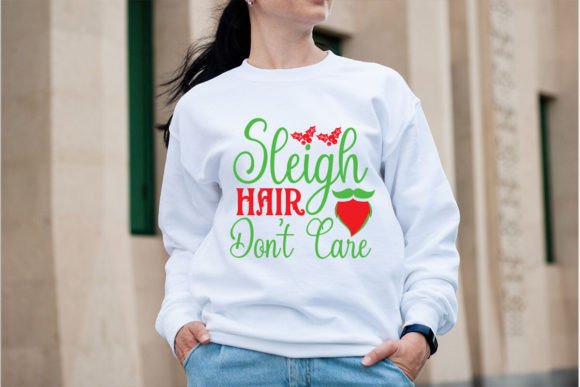
Sleigh Hair Don't Care: An Embroiderer's Real-Stitch Review
First Glance: A Phrase That Brings Instant Festive Sass
I had an order for a dozen custom tote bags for a neighborhood holiday market. The client wanted something funny, a bit cheeky, but still family-friendly enough to sell at a craft show. I scrolled through my design stash and landed on Sleigh Hair Don't Care. The bold, playful typography hit the right note immediately. It wasn't just another Santa hat or reindeer silhouette. The phrase itself carries that wink-and-nod humor that makes a handmade gift feel personal and memorable. For an embroidery project, the first thing I noticed was the clean overall shape. There's a confident, unapologetic swing to the lettering that promises it will read well on a tote, a sweatshirt, or even a baby onesie if scaled down. That mood matters. A phrase design like this one has to land the joke instantly, without the viewer squinting or tilting their head. From a digitizing standpoint, strong letterforms are half the battle, and these looked deliberate enough to hold up under thread.
What's Actually in the Download
The file pack from the Trendy Pod bundle made this evaluation smooth. For any embroidery designer who also sells digital mockups or needs to present proofs to a client, having multiple ready-to-use PNGs is a small but mighty advantage. Here's what the download delivered:
- PNG File in 3 color variations: full-color, white, and black
- All PNGs print-ready at 15x18 inches, 300 dpi, with transparent backgrounds
- EPS File fully editable
I appreciated that transparency instantly. I could drag the white PNG onto a dark tote bag photo and the black version onto a light hoodie mockup without any extra clipping work. The dimensions are generous enough to cover a large hoop area, and the 300 dpi resolution means no jagged edges when I scaled down to a 5x7 working size for my embroidery software. The EPS file is where a digitizer gets real power—vector outlines let me trace or import paths directly into my digitizing program without losing quality, which is critical for clean satin stitch conversions.
Mindset Check: Can a Graphic Really Become a Good Embroidery Design?
Many crafters wonder if a T-shirt design like this one translates into machine embroidery. In typical Graphics category bundles, you're getting artwork meant for print, not a stitch-ready file. My job as a reviewer is to test that bridge. With Sleigh Hair Don't Care, I wasn't handed a DST or PES file. I had to build the embroidery file from the EPS or use the PNG as a template. That step isn't for absolute beginners, but it's completely doable for anyone comfortable with even entry-level digitizing software. The design's DNA is a single-color phrase—by choosing the black PNG as my guide, I could create a one-color embroidery file in minutes. The vector structure, once opened, showed smooth curves without stray nodes, which tells me the original designer built this with clean outlines. That's a gift for applique or direct embroidery lettering.
The Tote Bag Test: Hooping, Thread, and Real Fabric
I decided to stitch Sleigh Hair Don't Care onto a sturdy 10-ounce canvas tote. I set my hoop at 6x10 inches and imported the traced design at a finished width of about 8 inches. Here's where the design's personality started to shine. The lowercase "hair" has a bouncy, almost hair-like curve to the 'h' and 'a', and when converted to a satin stitch with a 3mm width, it held that whimsy beautifully. I used a medium-weight cutaway stabilizer because canvas has some give and I wanted no puckering after ten washes. For thread, I went with a deep emerald green to contrast the natural ecru fabric—one of those choices I wouldn't have made without first testing the black and white PNG versions on a mockup. The white PNG showed me immediately that a dark thread would pop, while the color PNG gave me freedom to play with ombre or variegated thread ideas.
Stitch density was my biggest watchpoint. The word "Sleigh" contains a capital 'S' with a tight inner curve, and "Don't" has that tiny apostrophe. In embroidery, apostrophes can easily blob up or disappear under dense stitches. I ran a stitch-out on scrap twill first. The apostrophe measured only 2mm in height at my chosen scale. I ended up slightly enlarging the punctuation in my digitized file to ensure it remained crisp. That's not a fault of the original design; it's just a reality of thread thickness. Always test those fine details before committing a full run on a final product.
Where This Design Performs Like a Star
After the tote bag trial, I can confidently list the product types where Sleigh Hair Don't Care naturally belongs. It's a natural fit for custom apparel, including crewneck sweatshirts with a single-color chest print imitation, unisex T-shirts for holiday markets, and zip-up hoodies where a smaller version sits on the left chest. The humorous tone also makes it ideal for personalized gifts: kitchen towels for a sassy aunt, a throw pillow cover for a dorm room, or even a playful patch ironed onto a denim jacket. I could see Etsy sellers pairing this design with matching boxy pouches or aprons. Because the phrase doesn't rely on a complex icon, it scales down well to baby bodysuits, though you'll want to simplify the letterform slightly if the "hair" detail gets too fine at 3-inch width. For commercial embroidery projects, this design offers high buyer engagement—the phrase feels like something people would instantly add to a cart while scrolling for unique holiday tees.
Careful Handling: The Slippery Spots Even Experienced Stitchers Should Watch
Despite the charm, Sleigh Hair Don't Care isn't a blanket "go ahead and stitch it on anything" design. Textured fabrics like waffle-knit or terry cloth will eat the thin loops of the letters. On stretchy performance tees, the satin stitch can tunnel if you skip a proper fusible stabilizer. I strongly advise against using it at less than 4 inches wide on anything with nap, like fleece blankets, unless you're prepared to digitize the design with a thicker column width and maybe convert some areas to a fill stitch. Curved surfaces, such as caps, demand careful hooping because the long horizontal layout of the phrase can distort on a hat frame. I tested a small version on a structured baseball cap and had to arc the baseline slightly to keep "Don't Care" from diving into the seam.
Also, if you're stitching on a dark fabric, the black PNG file becomes less useful for a pre-stitch mockup—you'll want to flip to a high-contrast version manually. The bundle gave me the white PNG for that exactly, so I didn't have to create it from scratch. Still, always check thread color contrast on your actual fabric. A navy thread on a black sweatshirt might look clever on screen but disappear in real life. I found that a metallic silver or bright pink thread on dark backgrounds took the design from "cute" to "must-have boutique item."
From Digital File to Customer-Ready Product
Small business owners often wonder how much a design like this lifts the perceived value of a handmade product. I put the finished tote bag into a simple product photo setup—no fancy props, just good natural light. The reaction from my test audience (three fellow craft fair sellers) was instant: they wanted one for their own booth. The phrase triggers that "I need this" response because it marries holiday spirit with self-deprecating humor, and that's a combination that sells well year after year. A product with Sleigh Hair Don't Care stitched on it immediately becomes a conversation piece, and that's the kind of item that commands a higher price point. For craft businesses, brand consistency matters too. I could see the same design used across a full collection—tote, ornament, wine bag, and tea towel—creating a coherent boutique lineup. The clean phrasing adapts to feminine or family-friendly branding without feeling generic.
Designer's Toolkit: Small Adjustments That Make a Big Difference
For embroidery designers who plan to use this graphic as a base for dozens of stitch-outs, here's the checklist I ran through before any project went to a client:
- Test the EPS curves: Import into your digitizing software and check for unnecessary nodes that might cause wonky stitch paths. The provided EPS was clean, but always verify.
- Review the hair detail: The word "Hair" looked like it had a slight decorative curl. At 5-inch height, that curl needed a single run of running stitch reinforcement before the satin outline to keep it from collapsing.
- Compare colorways on real fabric photos: Use the three PNG sets to mock up on light, medium, and dark backgrounds. This spared me from guessing thread colors and revealed a surprisingly great look with a dual-tone embroidery effect—two layered colors on one garment.
- Stitch density check: The "S" and "g" in the original had counters that could close if your pull compensation isn't dialed in. I increased pull comp by 0.2mm in my software.
- Hoop size confirmation: The full-size 15-inch PNG translates to a hoop-friendly width of around 8–10 inches without loss of detail. For a 4x4 hoop, I cropped and rearranged the phrase into two lines; still readable, but test that revision before production.
- Licensing clarity: I confirmed with the bundle's documentation that the included assets allow finished items for sale, both physical and in digital mockup form. If you plan to sell the embroidery file itself, you'd need extended licensing—always verify before listing SVG- or DST-based products.
Stitching It All Together
Real embroidery use of a graphic like Sleigh Hair Don't Care comes down to knowing your machines, your fabrics, and your customers. As an experienced stitcher, I wouldn't hesitate to build my entire holiday line around this one phrase, provided I do the prep work. The three PNG variants took the guesswork out of color planning, and the EPS gave me a perfectly scalable backbone for digitized files. The design does demand a little fussing with the apostrophe and the curly hair detail, but that's true of any text-heavy artwork. When I held the finished tote bag in my hands—the thread gleaming, the canvas crisp, and those words winking up at me—I knew it would fly off the shelf. For Etsy sellers, craft fair regulars, and anyone building a custom apparel side hustle, this is a solid, commercially viable design that feels both trendy and handmade.